FYID-Feiyide
G168 Track-Type Intelligent Automatic Orbital Welding Machine — MIG/MAG/FCAW All-Position Pipe Welder ≥Φ219mm, 5–100mm Wall
G168 Track-Type Intelligent Automatic Orbital Welding Machine — MIG/MAG/FCAW All-Position Pipe Welder ≥Φ219mm, 5–100mm Wall
Couldn't load pickup availability
G168 Track-Type Intelligent Orbital Welding Machine — MIG/MAG/FCAW All-Position Automatic Pipe Welder for Pipe Diameter ≥ Φ219 mm, Wall Thickness 5 mm to 100 mm
The FYID-Feiyide G168 is a track-mounted intelligent automatic orbital welding system designed for all-position girth welding on large-diameter industrial pipe with wall thicknesses from 5 mm to 100 mm. The system supports MIG, MAG, FCAW (Flux-Cored Arc Welding), GMAW, standard pulse, and double-pulse welding processes — making it one of the most process-versatile automatic pipe welding systems available for carbon steel, stainless steel, alloy steel, and low-temperature steel applications.
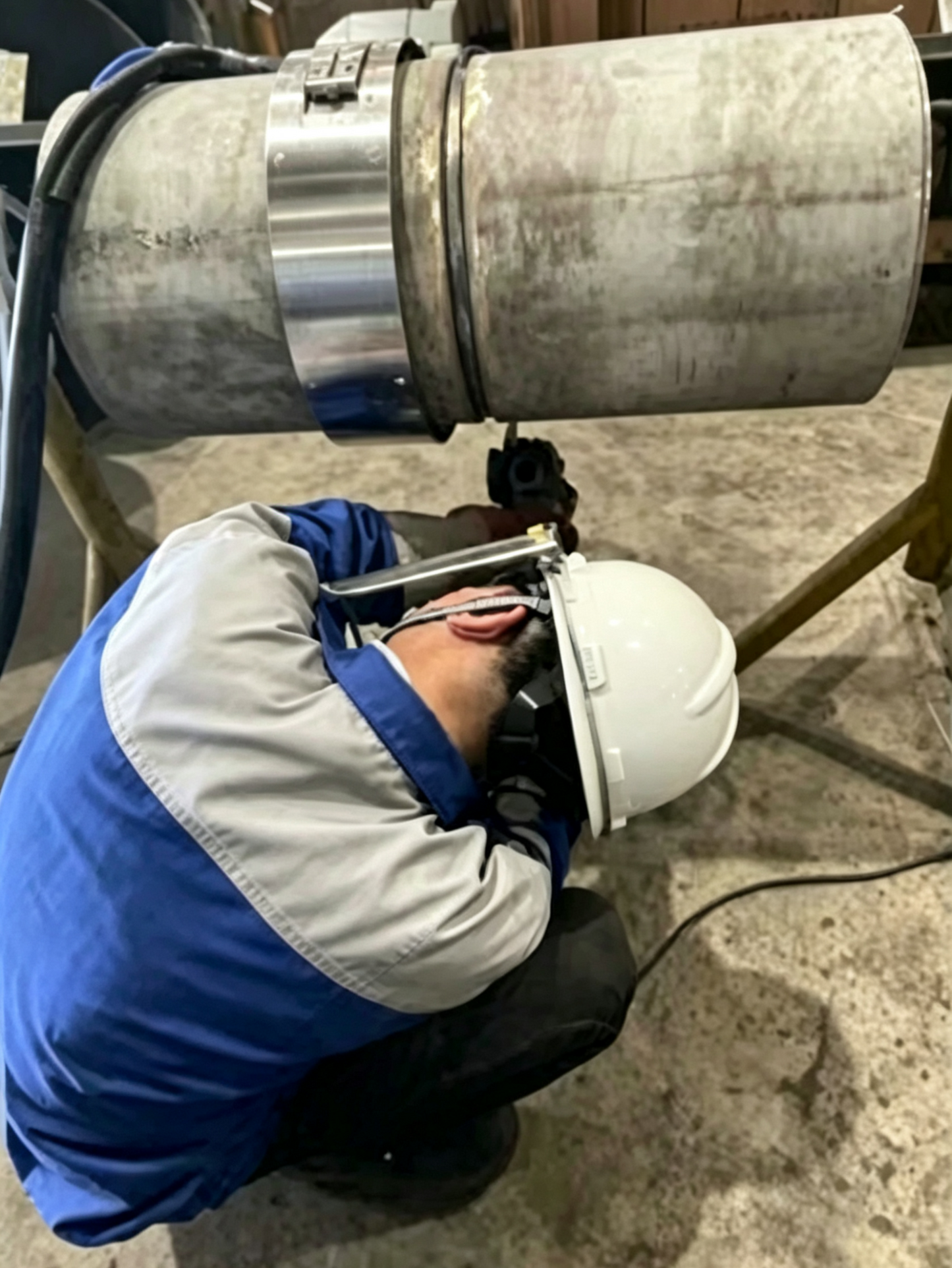
Unlike clamp-type orbital welding heads that require a fixed mounting interface, the G168 travels along a customized spring-steel track that is installed directly onto the pipe. The track system accommodates pipe diameters from Φ219 mm upward with no upper diameter limit, covering large-bore transmission pipelines, offshore riser piping, structural pipe piles, and large-diameter pressure vessels that fall outside the range of conventional orbital welding clamps.
The G168 integrates dozens of patented technologies across automatic welding control, multi-axis electronic servo drive, intelligent zone-based parameter control, and electronic fault detection. The power control system is built around a Finland KEMPPI full-digital gas-shielded welding power source — a globally recognized industrial-grade platform specified for low-spatter, high-deposition, high duty cycle production welding. Wireless WiFi remote control via a 5-inch color touchscreen allows complete weld parameter adjustment from a safe distance during the weld cycle, without operator proximity to the arc.
Welding efficiency with the G168 is 3 to 4 times higher than manual SMAW (Stick welding) on equivalent pipe joints, with consistent, repeatable weld properties across every joint in the production run — independent of operator skill variability or fatigue.
G168 System Composition — Welding Head, Power Control System, and Remote Control Unit
The G168 automatic orbital welding system consists of three integrated subsystems that operate together as a complete production welding platform:
G168 Welding Head — Track-Mounted All-Position Orbital Drive Unit
The G168 welding head is the orbital drive and torch positioning unit that travels along the pipe-mounted track. It houses the constant-torque drive motor, stepper motor X/Y oscillation axes, AVC (Arc Voltage Control) vertical motion system, integrated wire feeder, and the angle sensor that provides positional feedback for the 12-zone or 24-zone automatic parameter control system. The welding head mounts to the track via the quick-buckle interface and can be installed and removed in under 1 minute. Head dimensions are 231 × 306 × 230 mm (436 × 306 × 239 mm with wire feeder system); head weight is 11 kg.
KEMPPI Full-Digital Power Control System — MIG/MAG/Pulse/Double-Pulse
The G168 power control system is built around a Finland KEMPPI full-digital gas-shielded welding power source. KEMPPI power sources are specified for industrial production welding applications requiring low spatter, fast welding speed, high duty cycle, and arc waveform stability across the full current and voltage range. The integrated structure houses all components — power source, wire drive, cooling system, and control electronics — in a single mobile unit on universal wheels, suitable for on-site movement in harsh field welding environments.
5-Inch Wireless WiFi Remote Control Unit — Hand-Held Touchscreen Interface
The G168 remote control unit is a hand-held 5-inch high-definition color touchscreen that communicates with the welding head and power source via wireless WiFi. The remote allows the operator to adjust all weld parameters in real time during the weld cycle — welding bead selection, welding speed, wire feeding speed, oscillation action, vertical (AVC) motion, and arc length correction — without approaching the arc. Manual and automatic operating modes can be switched directly from the touchscreen. The remote fits in one hand and is ergonomically designed for field use in all weather conditions.
Core Patented Technologies in the G168 Track-Type Orbital Welding System
Constant-Torque Drive Motor — Precise All-Position Travel Speed
The G168 welding head is driven by a constant-torque motor that maintains precise rotational positioning and constant travel speed from flat (0°) through vertical (90°) to overhead (180°) and back through the full 360° circumference. In track-type orbital welding on large-diameter pipe, the drive motor must overcome varying gravitational load as the head traverses overhead and vertical positions on a large-radius track. The constant-torque design compensates for this load variation, maintaining the programmed travel speed without deviation at any position — ensuring consistent heat input per unit length and uniform bead geometry throughout the full joint.
Lightweight Head with Ultra-Narrow Body — Confined-Space Access and Reduced Operator Fatigue
The G168 welding head is designed with a lightweight body (11 kg) and ultra-narrow profile (306 mm width). The compact geometry allows the head to be installed and operated in confined pipeline trenches, offshore platform pipe decks, ship compartments, and industrial plant piping corridors where large welding head assemblies cannot fit. The lightweight body significantly reduces operator fatigue during installation, repositioning, and removal across high–joint-count production runs — particularly on cross-country pipeline projects where the system may be repositioned dozens of times per day.
Fully Enclosed Bottom Structure — Debris Exclusion (Exclusive Patent)
The G168 welding head incorporates a fully enclosed bottom structure, an exclusive FYID-Feiyide patent. The enclosed base prevents iron filings, weld spatter, grinding debris, and pipe scale from entering the mechanical drive components of the welding head during fabrication. In field pipeline welding environments — where grinding of weld caps, removal of tack welds, and thermal cutting operations occur in close proximity to the welding equipment — debris ingress is a primary cause of premature drive mechanism wear and electronic control failures. The enclosed bottom structure significantly extends service life and reduces unplanned maintenance compared to open-base track welding head designs.
High Dynamic Performance and Output Torque — Weld Quality Stability on Large-Radius Tracks
The G168 drive system is engineered for high dynamic performance and high output torque throughout the rotational cycle. On large-diameter pipe (Φ500 mm, Φ1000 mm, and above), the track radius is large and the gravitational load vector acting on the drive motor changes significantly between flat, vertical, and overhead positions. High dynamic torque output ensures that travel speed deviations caused by these gravitational load changes are corrected within milliseconds, maintaining the programmed travel speed specified in each zone of the weld program. This mechanical stability is the primary factor ensuring consistent bead width, penetration, and fusion characteristics from root pass to cap pass on large-bore heavy-wall pipe.
Stepper Motor X/Y Axis Control — Precision Oscillation Positioning
Transverse oscillation (weaving) of the welding torch is controlled by stepper motors on the X and Y axes. Stepper motor control provides closed-loop positioning accuracy in fractions of a millimeter, ensuring that oscillation width (2 mm – 30 mm, continuously adjustable), left dwell time (0 – 2 s), right dwell time (0 – 2 s), and oscillation speed (0 – 50, continuously adjustable) are executed to the programmed values at every position in the rotation cycle. In all-position welding on heavy-wall pipe, precise oscillation control is critical for consistent edge tie-in and inter-pass bead placement across 5 mm to 100 mm wall thicknesses. The stepper motor architecture eliminates the positioning drift that characterizes DC motor oscillation systems.
Intelligent Pendulum Oscillation — Up to 100 mm Wall Thickness Capability
The G168's intelligent pendulum oscillation (OSC) function dynamically adjusts oscillation parameters — width, frequency, and dwell — based on the programmed weld zone and layer, enabling consistent multi-pass fill welding in deep V-groove and U-groove joints on pipe walls up to 100 mm thick. This 100 mm wall capability is a globally significant breakthrough in all-position automatic orbital welding, extending machine welding into the territory of the heaviest pipeline, offshore riser, and structural pile specifications previously accessible only to semi-automatic or manual GMAW. Layer thickness per pass is recommended at ≤ 5 mm; for a 10 mm wall pipe, a 2-layer sequence is the standard setup.
12-Zone and 24-Zone Intelligent Partition Control — Automatic Parameter Adjustment by Position
The G168's automatic welding control system divides the 360° pipe circumference into either 12 zones (30° each) or 24 zones (15° each), with each zone carrying independent welding parameters. An internal angle sensor provides real-time positional feedback to the control system, triggering automatic parameter transitions as the welding head crosses zone boundaries. This zone-based architecture replicates the positional parameter adjustments that a certified manual welder makes instinctively — increasing current and reducing travel speed at overhead, adjusting oscillation dwell for horizontal — but executing these adjustments consistently, zone-by-zone, weld-by-weld, without operator intervention or fatigue effects. The 24-zone configuration provides finer positional control for critical applications where parameter transitions must be closely managed.
KEMPPI Intelligent Fusion Expert Program — Arc Waveform Control and Short-Circuit Stabilization
The KEMPPI power source integrated into the G168 includes an intelligent fusion expert program that adds controlled short-circuit characteristics to both standard GMAW and pulsed GMAW modes. The computer-controlled arc waveform tracking system monitors and adjusts the arc waveform in real time to keep the molten pool in the optimum position throughout each zone — enabling flat-characteristic GMAW and pulsed GMAW with reliable arc stability and minimal spatter. This arc waveform management is particularly important in all-position welding where the weld pool behavior changes significantly between flat, vertical, and overhead positions due to gravitational effects on the liquid metal.
Exclusive Quick-Buckle Track System — 1-Minute Installation
The G168 operates on a customized track equipped with an exclusive FYID-Feiyide patented quick-buckle system. The track can be fully assembled and disassembled on the pipe in 1 minute, enabling rapid repositioning between joints on a production run — a critical efficiency factor on cross-country pipeline projects where hundreds of joints must be welded in sequence. The track features a retractable support block design for self-adaptive stability on varying pipe surface conditions, and a gear-type occlusal engagement system that provides high-precision head travel with zero backlash — directly contributing to bead geometry accuracy and weld quality. The track material is high-quality spring steel with outstanding wear resistance, low-temperature resistance (to −40°C), oxidation resistance, and corrosion resistance, with high yield strength, high fatigue strength, and sufficient toughness for repeated field use.
Track width is only 110 mm. For thermal insulated pipe, the track can be installed and operated without cutting the insulation layer — a significant practical advantage for in-service piping rehabilitation and hot-tap welding applications that eliminates insulation removal and replacement costs.
G168 System Technical Specifications — Welding Head and Power Control System
G168 Welding Head — Full Technical Parameters
| Parameter | Specification |
|---|---|
| Model | G168 |
| Operating voltage | DC 12 V – 35 V; typical DC 24 V; rated power < 100 W |
| Welding current range | 80 A – 500 A |
| Welding voltage range | 16 V – 35 V |
| Welding speed | 50 – 900 mm/min, continuously adjustable (unlimited) |
| Wire feeding speed | 0 – 2500 mm/min |
| Oscillation speed | 0 – 50 (continuously adjustable) |
| Oscillation width | 2 mm – 30 mm, continuously adjustable |
| Dwell time (left/right, independent) | 0 – 2 s, continuously adjustable per side |
| Head angle adjustment | ± 15° |
| Applicable pipe diameter | ≥ Φ219 mm (no upper limit) |
| Applicable wall thickness | 5 mm – 100 mm |
| Welding wire diameter | Φ1.0 mm – Φ1.2 mm |
| Welding zone control | 12-zone or 24-zone automatic partition control (internal angle sensor) |
| Drive motor | Constant-torque motor (all-position travel speed stability) |
| Oscillation axis control | Stepper motor, X/Y dual-axis |
| Track installation time | ≤ 1 minute (exclusive quick-buckle patent) |
| Track width | 110 mm (fits over thermal insulation without cutting) |
| Track material | High-quality spring steel (wear, low-temp, oxidation, and corrosion resistant) |
| Remote control | Wireless WiFi; 5-inch HD color touchscreen; single-hand operation |
| Operating temperature | −20°C to +60°C |
| Storage temperature | −20°C to +60°C |
| Ambient temperature range (site) | −40°C to +75°C |
| Ambient humidity | 20% – 90% (no condensation) |
| Dimensions (welding head) | 231 × 306 × 230 mm |
| Dimensions (with wire feeder) | 436 × 306 × 239 mm |
| Weight (welding head) | 11 kg |
Power Control System (KEMPPI Full-Digital) — Full Technical Parameters
| Parameter | Specification |
|---|---|
| Welding processes | MIG, MAG, FCAW, GMAW, Pulse GMAW, Double-Pulse GMAW |
| Power voltage input | 3-phase, 50/60 Hz, 400 V (−15% / +20%) |
| Rated power at 60% ED | 22.1 KVA |
| Rated power at 100% ED | 16.0 KVA |
| Output current at 60% ED | 500 A |
| Output current at 100% ED | 390 A |
| Welding current range (MIG) | 10 A – 500 A |
| Welding voltage range (MIG) | 10 V – 50 V |
| No-load voltage (MIG/MAG/Pulse) | 80 V |
| No-load power | 100 W |
| Power factor (at max current) | 0.9 |
| Efficiency (at max current) | 88% |
| Fuse (delayed) | 35 A |
| Min. short-circuit capacity (Ssc) | 5.5 MVA |
| EMC level | Class A |
| Protection grade | IP23S |
| Auxiliary device supply | 50 V DC / 100 W |
| Cooling device supply | 24 V DC / 50 VA |
| Storage temperature range | −40°C to +60°C |
| Dimensions (L × W × H) | 690 × 320 × 830 mm |
| Mobility | Universal wheels on base; integrated structure; field-portable |
Welding Process Parameters — Consumables and Shielding Gas
| Parameter | Specification |
|---|---|
| Shielding gas options | CO₂ (100%) or mixed gas (80% Ar + 20% CO₂) |
| Welding wire type | Solid wire or flux-cored wire (FCAW) |
| Welding wire diameter | Φ1.0 mm – Φ1.2 mm |
| Recommended layer thickness per pass | ≤ 5 mm per layer (e.g., 2 layers for 10 mm wall; up to ~20 layers for 100 mm wall) |
| Compatible materials | Carbon steel, stainless steel, alloy steel, low-temperature steel |
G168 vs. Manual SMAW — Efficiency Comparison
| Criterion | G168 Automatic Orbital MIG/MAG | Manual SMAW (Stick Welding) |
|---|---|---|
| Welding speed | 50 – 900 mm/min (programmable) | Typically 80 – 200 mm/min (welder dependent) |
| Deposition rate | High (GMAW continuous wire; up to 500 A) | Low (electrode changes; 60–80% arc-on time typical) |
| Relative efficiency | 3–4× higher than manual SMAW | Baseline reference |
| Weld consistency | Program-controlled; operator-independent | Welder skill and fatigue dependent |
| Spatter level | Low (KEMPPI arc waveform control) | Higher (process dependent) |
| All-position capability | Yes — 12/24-zone automatic parameter control | Yes — certified welder required per position |
| Documentation | Digital parameter storage and recall; WiFi remote logging | Manual WPS compliance only |
Industry Applications for the G168 Track-Type Intelligent Orbital Welding System
Cross-Country Gas, Oil, and Water Transmission Pipeline Construction
Cross-country pipeline construction represents the highest-volume application for track-type orbital welding systems. Pipelines for natural gas, crude oil, refined products, and water transmission are typically constructed in API 5L grades (Grade B through X80) with pipe diameters from Φ219 mm to Φ1422 mm and wall thicknesses from 6 mm to 25 mm or more. Each joint must meet API 1104 or equivalent standard, with 100% radiographic or AUT inspection on high-consequence segments.
The G168's quick-buckle track system (1-minute installation) enables rapid head repositioning along the right-of-way as construction advances — a critical production factor when a pipeline spread must complete 40 to 80 joints per day. The 12-zone automatic parameter control ensures consistent all-position weld quality on each joint without requiring a certified welder to monitor every pass. Efficiency 3–4× higher than manual SMAW directly translates to reduced project schedule and labor cost per kilometer of installed pipe.
Offshore Platform Piping, Flowlines, and Risers
Offshore platform structural piping, topside process piping, flowlines, and riser systems present the most demanding combination of requirements for automatic orbital welding: all-position welding in all attitudes (5G fixed-position), high-wind and high-humidity environments, saltwater corrosion exposure, and structural certification requirements from classification societies (DNV GL, Bureau Veritas, Lloyd's Register, ABS). The G168's IP23S-rated power control system and −40°C to +75°C site operating temperature range meet offshore environmental requirements. The 24-zone parameter control provides the fine positional resolution required for riser and flowline joints where specification-compliant weld profiles must be achieved at every position.
Steam Piping and District Heating Networks
Steam piping for power plants, industrial facilities, and district heating networks involves large-diameter heavy-wall carbon steel pipe welded to ASME B31.1 or EN 13480 standards, with alloy steel grades (P11, P22, P91) on high-temperature and high-pressure systems. The G168's 110 mm narrow track design is particularly advantageous for pre-insulated district heating pipe: the track installs over the existing insulation without cutting, enabling girth weld completion without insulation removal and replacement — reducing both project cost and thermal performance disruption on in-service network extensions.
Chemical Process Piping and Petrochemical Plants
Chemical process piping systems involve multi-material specifications — carbon steel, stainless steel, alloy steel, and low-temperature steel — often in close-coupled manifold configurations within plant structures. The G168 supports all four material groups with appropriate shielding gas selection (CO₂ for carbon steel; Ar/CO₂ mix for stainless and alloy steel). The 24-zone automatic parameter control accommodates the position-specific welding challenges of piping joints within plant pipe racks, where structural steel obstructs manual welder access but the track-mounted G168 head can traverse the full circumference without obstruction.
Large-Diameter Pressure Vessels, Tanks, and Pipe Piles
Horizontal and vertical seam welding on large-diameter pressure vessels, storage tanks, and structural pipe piles (Φ219 mm and above, including pile diameters exceeding Φ1000 mm) is a direct application for the G168's unlimited upper pipe diameter capability. The track-based system accommodates any pipe or vessel OD by adjusting track segment count, making it the only type of orbital welding system that scales to vessel and pile diameters beyond the range of all clamp-type heads. For tubular structure pile welding in marine and civil construction, the G168's outdoor operation capability (−40°C to +75°C ambient) and IP23S protection enable continuous production in exposed construction site conditions.
Buried Pipeline Rehabilitation and In-Trench Welding
Buried pipeline rehabilitation — hot-tap fitting installation, sleeve welding, and joint repair on in-service pipes — requires welding in confined trench conditions in all positions. The G168's 11 kg lightweight head and ultra-narrow 110 mm track profile enable installation and operation in trench widths that cannot accommodate manual welding equipment with equivalent output. For insulated buried pipelines, the narrow track eliminates the requirement to excavate and remove insulation over the joint area before welding — a significant cost and schedule benefit on rehabilitation projects.
G168 Key Features and Production Benefits Summary
| Feature | Production Benefit |
|---|---|
| KEMPPI full-digital MIG/MAG/Pulse/Double-Pulse power source | Low spatter, fast welding, ultra-high duty cycle, arc stability in all positions |
| 12-zone / 24-zone intelligent partition control (angle sensor) | Automatic parameter adjustment by position — consistent all-position weld quality without operator intervention |
| Exclusive quick-buckle spring-steel track (1-minute installation) | Rapid repositioning between joints; high joint-count production efficiency |
| 110 mm narrow track — installs over pipe insulation | No insulation removal required on thermal or buried pipe — reduced project cost |
| Wireless WiFi 5-inch touchscreen remote control | Real-time parameter adjustment from safe distance; one-hand operation; no arc proximity required |
| Stepper motor X/Y oscillation (2–30 mm width, 0–2 s dwell) | Wide groove capability — suitable for narrow gap, wide gap, thin and thick pipe; precise edge tie-in |
| Intelligent pendulum oscillation — up to 100 mm wall | Machine welding on the heaviest wall specifications — replaces manual SMAW/FCAW on thick-wall joints |
| Lightweight head 11 kg, ultra-narrow body | Confined-space access; reduced operator fatigue; rapid installation on high–joint-count projects |
| Fully enclosed bottom structure (exclusive patent) | Debris exclusion — extended service life; reduced maintenance in field environments |
| Digital parameter storage, recall, and self-diagnosis | WPS-compliant program recall; eliminates operator-to-operator quality variability; supports audit documentation |
| Efficiency 3–4× higher than manual SMAW | Shorter project schedule; lower labor cost per joint; higher daily joint count |
| −40°C to +75°C site operating range; indoor and outdoor | Unrestricted field deployment — Arctic pipelines, offshore platforms, desert petrochemical plants |
G168 Orbital Welding Machine — Frequently Asked Questions
What is the minimum pipe diameter the G168 can weld, and is there a maximum?
The G168 is rated for pipe outer diameters of Φ219 mm and above. There is no specified upper diameter limit — the track system is assembled from segments that can be configured for any pipe OD, including large-diameter transmission pipelines (Φ610 mm, Φ914 mm, Φ1067 mm, Φ1422 mm) and very large pressure vessels or pipe piles. This unlimited upper diameter capability is a fundamental advantage of track-type orbital systems over clamp-type heads, which are constrained by their fixed mechanical geometry. For pipe diameters below Φ219 mm, FYID-Feiyide offers alternative orbital welding systems (FXT40 Pro K-Series for open-head TIG down to Φ20 mm; FXT20 C-Series for enclosed-head TIG on thin-wall tube).
What welding processes does the G168 support, and which is recommended for carbon steel pipeline welding?
The G168 supports MIG, MAG, FCAW (Flux-Cored Arc Welding), GMAW, standard pulse GMAW, and double-pulse GMAW — all driven by the KEMPPI full-digital power source. For carbon steel transmission pipeline welding (API 5L Grade B through X70), MAG with CO₂ or Ar/CO₂ mixed shielding gas (80% Ar + 20% CO₂) is the standard process. Ar/CO₂ mixed gas is generally preferred for its lower spatter level and better arc stability compared to 100% CO₂, particularly in pulse and double-pulse modes where arc waveform control is critical. FCAW (flux-cored wire) is recommended for high-deposition fill passes on heavy-wall pipe where increased deposition rate is a priority over minimal spatter.
How does the 12-zone vs. 24-zone partition control system work, and when should 24 zones be used?
The G168 divides the 360° pipe circumference into either 12 zones (30° each) or 24 zones (15° each). An internal angle sensor provides real-time positional feedback, and the control system automatically applies the programmed parameters for each zone as the welding head crosses zone boundaries. In 12-zone mode, parameter transitions occur every 30° — adequate for most standard pipeline and process pipe applications. In 24-zone mode, transitions occur every 15°, providing finer positional control. 24-zone mode is recommended for: heavy-wall pipe (above 25 mm) where transitional parameter management between flat and overhead is critical; high-specification applications requiring tight control of bead geometry at overhead; and offshore or nuclear-adjacent applications where the welding procedure specification defines closely spaced positional parameter zones.
How long does it take to install the G168 track on a pipe joint, and what tools are required?
The G168 track system is designed for installation in under 1 minute using the exclusive patented quick-buckle mechanism. No special tools are required — the track segments snap and lock onto the pipe using the quick-buckle interface, and the retractable support blocks self-adapt to the pipe surface for stable contact. The gear-type occlusal track engagement with the welding head drive gear is established when the head is mounted onto the installed track. Total setup time from arriving at the joint to arc start — including track installation, head mounting, program recall, and pre-weld inspection — is typically 5 to 10 minutes on a previously qualified joint size. This rapid setup is a primary efficiency driver on high–joint-count pipeline construction projects.
Can the G168 weld stainless steel and low-temperature steel in addition to carbon steel?
Yes. The G168 is compatible with carbon steel, stainless steel, alloy steel, and low-temperature steel. For stainless steel, Ar/CO₂ mixed gas (80% Ar + 20% CO₂) or pure argon (depending on the specification) is used as shielding gas. For low-temperature steel grades (e.g., API 5L PSL2 at −40°C service, ASTM A333 grades for cryogenic applications), the KEMPPI power source's low-spatter arc waveform control and pulse capability enable weld heat input management to meet the impact toughness requirements of low-temperature service specifications. For alloy steel grades (Cr-Mo steels P11, P22), appropriate filler wire selection and preheat/interpass temperature control are required as specified in the applicable WPS.
What documentation and parameter traceability does the G168 provide for quality and inspection records?
The G168's 5-inch touchscreen remote control provides digital setting, modification, storage, and recall of all process parameters — enabling pre-weld qualification testing to establish the welding procedure, and then exact recall of those parameters for every production weld. Stored programs ensure that every weld in a production run is executed to the same parameter set as the qualified procedure, eliminating operator-to-operator variability. The self-diagnosis function logs system status and fault events. For projects requiring WPS/PQR documentation under ASME Section IX, API 1104, or classification society approval, the G168's program storage provides the parameter traceability basis for the weld record. Wireless WiFi communication logs real-time parameter data during welding for post-weld record correlation.
What is the G168's ambient operating temperature range, and is it suitable for Arctic or desert pipeline projects?
The G168 welding head operates from −20°C to +60°C; the site ambient temperature range is −40°C to +75°C. The track material (high-quality spring steel) maintains its mechanical properties — yield strength, fatigue strength, and toughness — throughout the full ambient range, including Arctic field conditions. The power control system stores and operates from −40°C to +60°C. This temperature range covers the full spectrum of international pipeline construction environments: Arctic permafrost pipelines, Northern European and Canadian winter construction, Middle Eastern desert petrochemical plants, and Southeast Asian tropical offshore platforms. For Arctic deployments, the Ar/CO₂ shielding gas mixture and enclosed bottom structure provide additional protection against the effects of extreme cold on arc stability and equipment longevity.
How does the G168 compare to semi-automatic FCAW (flux-cored arc welding) for pipeline construction?
Semi-automatic FCAW — where a welder manually guides the torch around the joint — is the dominant competing process for large-diameter heavy-wall pipeline welding. The G168 delivers three key advantages over semi-automatic FCAW: (1) Consistency — the 12/24-zone automatic parameter control eliminates positional parameter variation caused by individual welder skill and fatigue, producing consistent bead geometry and mechanical properties from the first joint to the hundredth; (2) Efficiency — at equivalent wire feed speeds and current levels, the G168's programmed travel speed optimization and continuous arc-on time produce 3–4× higher productivity than manual SMAW and measurably higher than semi-automatic FCAW where arc interruptions for welder repositioning reduce effective arc-on time; (3) Documentation — stored digital programs provide the parameter traceability required for modern pipeline QA documentation, whereas semi-automatic FCAW relies on welder compliance with the written WPS. The trade-off is that the G168 requires track installation time (≤1 minute per joint) and initial program qualification, which are offset by production efficiency gains on joint counts above 20–30 joints of the same specification.
For project-specific configuration, groove design consultation, welding procedure development, or quotation on the G168 welding head with KEMPPI power control system, track sets, and wireless remote control unit, contact FYID-Feiyide's applications engineering team. On-site commissioning and operator training support are available for all G168 deployments.
Text block