FYID-Feiyide
FYID FXT40 Pro Industrial Open-Head Orbital Welding System (400A Heavy-Duty TIG Welder for Φ20-325mm Pipes)
Couldn't load pickup availability
Open-Head Orbital TIG Welder for Heavy-Wall Industrial Pipe — Φ20 mm to Φ325 mm, Up to 13 mm Wall
The FYID-Feiyide FXT40 Pro is a 400 A industrial open-head orbital GTAW (TIG) welding system designed for all-position girth welding on large-diameter carbon steel, stainless steel, and titanium alloy pipe. The system pairs the FXT40 Pro digital power source with the K-Series open-head orbital welding clamps (K76 through K325), covering pipe outer diameters from Φ20 mm to Φ325 mm and wall thicknesses from 2 mm to 13 mm.
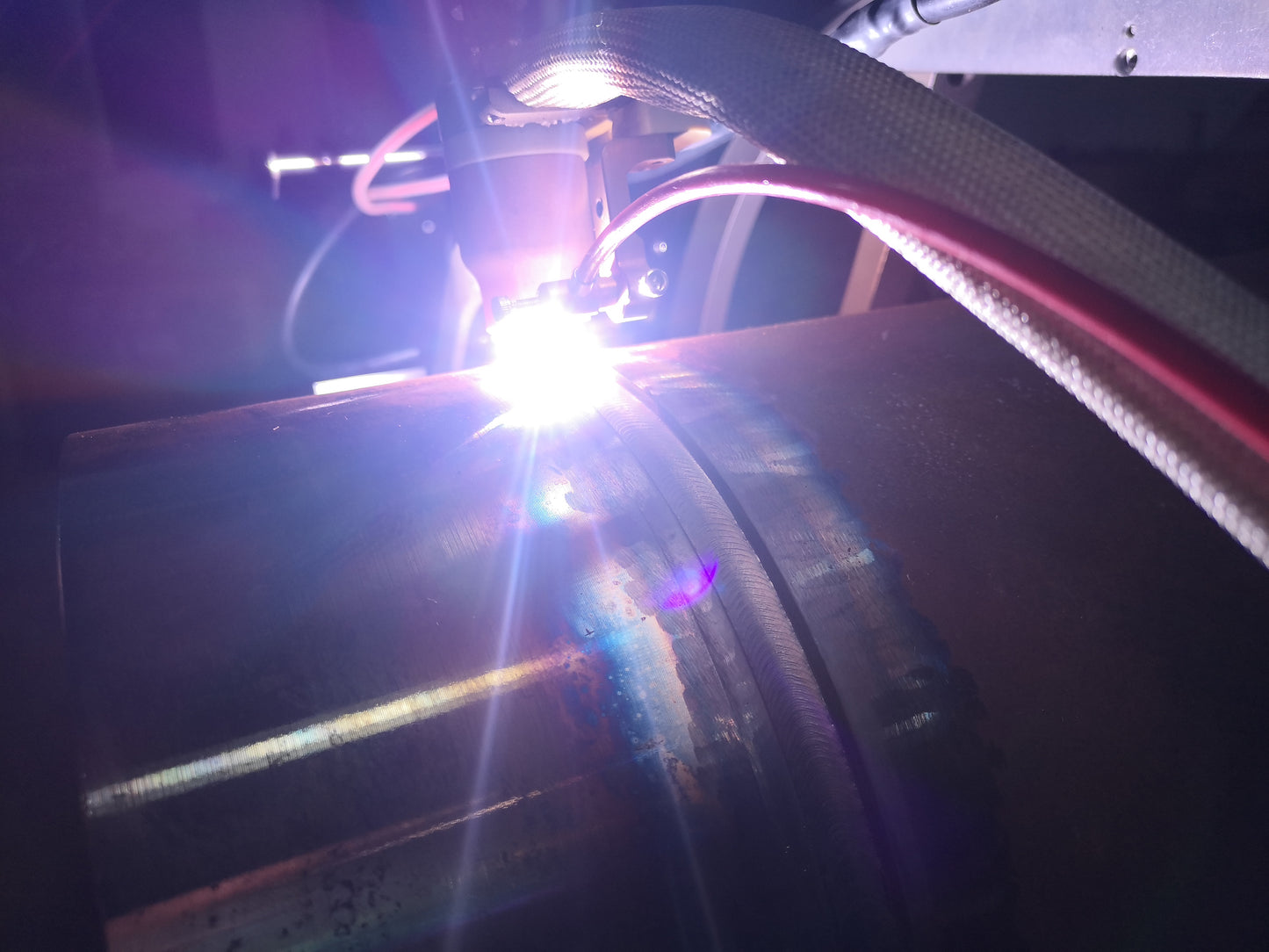
Unlike enclosed welding heads that require pipe-end access, the K-Series open-head clamp mounts externally onto the pipe at any accessible point along its length — making it the correct tool for in-situ manifold joints, skid-mounted piping, shipboard piping systems, and any application where both pipe ends are not free. The welding head rotates around the stationary pipe, completing a full 360° girth weld with programmable parameter control at every position: flat (1G/1F), horizontal (2G), vertical (3G), and overhead (4G).
The FXT40 Pro is controlled by a Siemens S7-200 SMART V3.0 PLC — an industrial-grade control platform specified for critical environments including nuclear auxiliary piping, shipbuilding, and high-pressure petrochemical pipelines where arc stability under variable grid conditions is a fabrication requirement, not a preference.
FXT40 Pro System Specifications — Power Source and K-Series Welding Heads
FXT40 Pro Power Source
| Parameter | Specification |
|---|---|
| Welding process | GTAW (TIG) — DC and Pulse modes |
| Output current range | 10 A – 400 A DC |
| Duty cycle | 315 A at 100% / 400 A at 60% (40°C ambient) |
| Open circuit voltage | 70 V |
| Input power | 380 V ±10%, 50/60 Hz, three-phase |
| Power consumption | 21.5 KVA |
| Control system | Siemens S7-200 SMART V3.0 PLC |
| HMI display | 10-inch color LCD touchscreen, Chinese/English |
| Welding zones | Up to 8 independent zones × 8 stages per zone |
| Stored programs | 50 groups (200 positions) |
| Torch cooling | Circulating water, 15 L water tank |
| Wire feeder spool | Up to 15 kg; wire diameter 0.8 / 1.0 / 1.2 mm |
| Operating temperature | −10°C to +40°C |
| Protection grade | IP21 |
| Machine weight | Approx. 108 kg |
| Dimensions (L×W×H) | 1050 × 480 × 1070 mm |
| Certifications | CE, ISO 9001 |
K-Series Open-Head Orbital Welding Clamps — Pipe Diameter Coverage
| Head model | Pipe OD range | Max wall thickness | Typical application |
|---|---|---|---|
| K76 | Φ20 – 76 mm | 13 mm | Instrument tubing, small-bore process pipe |
| K114 | Φ25 – 114 mm | 13 mm | Gas skid manifolds, chemical process pipe |
| K168 | Φ60 – 168 mm | 13 mm | Petrochemical piping, boiler headers |
| K219 | Φ114 – 219 mm | 13 mm | Shipbuilding, nuclear auxiliary pipe |
| K273 | Φ133 – 273 mm | 13 mm | Power station piping, large-bore industrial |
| K325 | Φ159 – 325 mm | 13 mm | Transmission pipeline, structural piping |
Welding process capabilities
The FXT40 Pro supports autogenous (no-filler) root passes and wire-feed fill and cap passes in the same program sequence. For pipe wall thicknesses above 2.5 mm, V-groove preparation (single bevel ≥37° for carbon steel, ≥45° for stainless steel) is required. The system's OSC (oscillation) function executes programmed transverse weaving with independently adjustable left and right dwell times for consistent cap weld width and edge tie-in. AVC (Automatic Arc Voltage Control) maintains torch standoff height in real time throughout each rotation — compensating for pipe surface variation and gravitational effects on the weld pool in overhead and vertical positions.
Industry Applications for the FXT40 Pro Open-Head Orbital Welding System
Petrochemical and Oil & Gas Pipeline Fabrication
Petrochemical plants and oil & gas facilities require girth welds on carbon steel and stainless steel pipe that meet ASME B31.3 (Process Piping) or B31.4/B31.8 (pipeline) code requirements, with 100% radiographic or ultrasonic inspection on critical service lines. Manual all-position TIG welding on large-diameter heavy-wall pipe is the highest-risk step in petrochemical piping fabrication: overhead and vertical-down passes require sustained physical effort, and welder fatigue directly correlates with inconsistent penetration and failed radiographic inspections.
The FXT40 Pro's 8-zone programming assigns independent current, travel speed, wire feed, and oscillation parameters to each quadrant of the pipe circumference — replicating the positional adjustments a certified manual welder would make, without the fatigue variable. AVC maintains constant arc length as the head rotates through overhead positions, where arc length variation is the primary cause of lack-of-fusion defects. The result is consistent weld bead geometry from 0° to 360°, with every parameter logged for radiographic record correlation. For high-pressure LPG, gas processing, and refinery unit piping where a single rework cycle adds significant schedule and cost, the FXT40 Pro reduces first-pass rejection rates to below 1% on qualified joint designs.
Compatible pipe materials: carbon steel (API 5L, ASTM A106), stainless steel (304, 316L), duplex stainless steel (2205). Compatible pipe OD: Φ20 mm to Φ325 mm. Wall thickness: 2 mm to 13 mm.
Shipbuilding and Marine Piping Systems
Shipboard piping systems — ballast, fuel, seawater cooling, and power plant piping — present a specific fabrication challenge: welds must be executed in confined compartments, in all positions, on pipe that is fixed in place within the ship structure. A manual TIG welder working in a ship's engine room or pipe alley is constrained by both access geometry and physical fatigue, producing a high variance in weld quality across a large joint count that spans hundreds of welds per vessel.
The K-Series open-head clamp design addresses the confined-space problem directly. The clamp mounts onto the pipe externally; the operator does not need to reach around or underneath the joint. Once the head is clamped and the program is loaded, the weld cycle runs without operator intervention. For shipbuilding projects that require classification society approval (Lloyd's Register, Bureau Veritas, DNV), the FXT40 Pro's per-weld data logging — current, voltage, travel speed, zone sequence — provides the parameter traceability required for weld procedure qualification records (WPS/PQR). The system stores 50 programs for instant recall on identical pipe specifications across repeat vessel builds.
The 315 A at 100% duty cycle rating sustains continuous two-shift production in shipyard environments. Water-cooled torch head prevents thermal shutdown during extended production runs in high-ambient temperature conditions.
Power Generation — Nuclear Auxiliary Piping and Boiler Systems
Nuclear auxiliary piping systems and power station boiler headers are among the most documentation-intensive welding scopes in industrial fabrication. Every joint must be qualified against ASME Section IX (Welding and Brazing Qualifications), with WPS and PQR documentation that traces material heat numbers, welder or machine qualification, preheat and interpass temperature, and weld parameter records. The Siemens S7-200 SMART PLC in the FXT40 Pro was selected for nuclear and power generation applications specifically because Siemens industrial PLC reliability is recognized in utility-grade quality programs — it is not a generic inverter controller.
The FXT40 Pro's per-weld parameter logging satisfies the traceability requirements of nuclear auxiliary piping quality programs. Current, travel speed, arc voltage, zone index, and timestamp are recorded for every weld cycle and available for USB export or optional printer output. For boiler economizer and superheater header welds on heavy-wall carbon steel — where preheat, interpass temperature control, and multi-pass sequencing are all specified — the 8-zone × 8-stage programming accommodates the full pass sequence in a single stored program, ensuring each production weld replicates the qualified procedure exactly.
Compatible specifications: ASME Section IX, ASME B31.1 (Power Piping), nuclear quality program documentation support.
Industrial Boiler and Pressure Vessel Manufacturing
Boiler drum headers, pressure vessel nozzle welds, and heat exchanger shell connections involve large-diameter heavy-wall pipe with multi-pass V-groove or U-groove joint designs that require consistent bead-on-bead placement across 8 to 20 passes per joint. Manual TIG on thick-wall boiler pipe is a slow, physically demanding process where each successive fill pass must maintain consistent tie-in to the previous bead — a requirement that becomes progressively harder as the welder fatigues across a multi-pass sequence that can take two to four hours per joint.
The FXT40 Pro's 8-zone × 8-stage programming structures each pass as a discrete stage within the zone program. Root pass parameters — lower current, slower travel, no oscillation — differ from fill pass parameters (higher current, OSC weaving) and cap pass parameters (wider oscillation, adjusted dwell). All stages execute sequentially in a single program run, and the system's AVC tracking compensates for the changing joint geometry as fill passes build up inside the groove. For ASME VIII pressure vessel fabrication or EN 13445-compliant boiler manufacturing, the FXT40 Pro's documentation output supports the weld traceability required for pressure equipment directive compliance.
Natural Gas Infrastructure and LPG Skid Fabrication
LPG vaporizers, pressure regulating stations, and natural gas filtration skid manifolds are fabricated to zero-leak standards — typically 100% radiographic inspection plus hydrostatic pressure testing on every joint. The piping manifolds inside a skid frame present a confined-access all-position welding requirement: joints at the top of the skid frame require overhead welding; joints on the side panels require vertical welding; and the dense manifold layout restricts manual welder positioning between adjacent joints.
A documented deployment of the FXT40 Pro with K114 head at an Indian natural gas engineering firm achieved 99.5% first-pass X-ray yield on LPG vaporizer manifold joints, reducing rework costs from 15% to below 1% of project labor. The K-series clamp's compact external geometry allowed the head to be repositioned between manifold joints inside the assembled skid frame without disassembly. Operator training to production proficiency took 3 days on the 10-inch touchscreen interface. For EPC contractors and skid OEMs building to Indian energy safety codes, ASME B31.3, or PED 2014/68/EU, the FXT40 Pro's combination of all-position capability, confined-access head design, and per-weld documentation satisfies both quality and regulatory requirements.
FXT40 Pro Orbital Welder — Frequently Asked Questions
What is the difference between the FXT40 Pro and a closed-head orbital welder like the FXT20?
The FXT20 with C-Series enclosed heads is designed for thin-wall tube (0.5 mm – 3 mm wall, up to Φ168 mm OD) in sanitary and high-purity applications such as pharmaceutical, food, and semiconductor piping. The enclosed head seals around the tube and provides a 360° argon chamber for oxidation-free welds on stainless steel without back-purging.
The FXT40 Pro with K-Series open heads is designed for heavy-wall industrial pipe (2 mm – 13 mm wall, Φ20 mm – Φ325 mm OD) in structural, petrochemical, shipbuilding, and power generation applications. The open-head clamp mounts externally and does not require pipe-end access, making it suitable for in-position joints inside assembled structures. Multi-pass V-groove welding with wire feed is the primary process, not autogenous single-pass welding.
Can the FXT40 Pro weld stainless steel pipe in addition to carbon steel?
Yes. The FXT40 Pro welds carbon steel, stainless steel (304, 316L, duplex 2205), and titanium alloy pipe. For stainless steel pipe above 2.5 mm wall thickness, V-groove preparation with a single bevel angle ≥45° is required. Back-purging with argon is recommended for stainless steel to prevent root-side oxidation — the FXT40 Pro system includes pre-flow and post-flow gas control to protect the weld pool before arc initiation and after arc termination.
How does the 8-zone programming system work for all-position pipe welding?
The pipe circumference is divided into up to 8 independently programmable zones (e.g., 0°–45° flat, 45°–90° vertical-up, 90°–135° overhead approach, 135°–180° overhead, 180°–225° overhead exit, 225°–270° vertical-down, 270°–315° horizontal, 315°–360° flat return). Each zone carries its own current, travel speed, wire feed rate, OSC oscillation width and dwell, and AVC tracking voltage settings. This allows the system to automatically apply the correct parameters for each position as the head rotates — replicating the adjustments a certified manual welder makes instinctively, but consistently and without fatigue.
What documentation does the FXT40 Pro produce for quality and inspection records?
The FXT40 Pro logs welding current, arc voltage, travel speed (degrees and distance), wire feed speed, zone index, and timestamps for every weld cycle. An optional built-in printer produces weld parameter reports on demand. Data is exportable via USB for unlimited archiving. This output supports WPS/PQR documentation for ASME Section IX qualification, radiographic inspection correlation records, and audit documentation for ISO, GMP, and nuclear quality programs.
What groove preparation is required for the K-Series heads on heavy-wall pipe?
For carbon steel pipe above 2.5 mm wall thickness: V-groove, single bevel angle ≥37°, fit-up gap 0 – 0.5 mm, misalignment ≤10% of wall thickness. For stainless steel pipe above 2.5 mm wall thickness: V-groove, single bevel angle ≥45°, same fit-up and alignment tolerances. Pipe below 2.5 mm wall does not require groove preparation for carbon or stainless steel. Groove preparation can be performed with FYID's split-frame pipe cutting and beveling machine for in-situ joint preparation without pipe removal.
Is the FXT40 Pro suitable for emergency repair welding in the field?
Yes, subject to the pipe OD and wall thickness falling within the K-series head range. The open-head clamp design requires no pipe-end access, making it suitable for in-service pipe that cannot be removed or cut. The system requires 380 V three-phase power input, 15 L of cooling water, and argon supply. For field deployments, portable argon cylinders and a portable three-phase generator are the standard setup. The 10-inch touchscreen allows stored programs to be recalled immediately for pipe sizes that have been previously qualified.
For project-specific pipe diameter coverage, groove design, or multi-pass program support, contact FYID-Feiyide's applications engineering team. Configuration options include individual K-series heads (K76 through K325) with the FXT40 Pro power source, wire feeder, and line controller.
Text block

Contact us for a quote
FAQ
-
What is the FXT40 Pro all-position pipeline automatic welding machine?
The FXT40 Pro is a professional-grade automatic pipeline welding system designed for all-position girth welding (flat, horizontal, and overhead). It features a Siemens S7-200 SMART PLC and AVC+OSC dual closed-loop control, making pipeline welding as simple as setting a navigation route. It is engineered to replace manual labor in demanding industries like petroleum, shipbuilding, and power energy.
-
How does the FXT40 Pro ensure weld quality in overhead and all-position welding?
The FXT40 Pro utilizes AVC (Automatic Arc Voltage Control) for real-time arc length tracking and OSC (Transverse Weaving) for precise bead formation. This combination allows for 360° automatic rotation without manual adjustment, ensuring a radiographic inspection pass rate of ≥98%, even in difficult overhead positions.
-
What pipe diameters and wall thicknesses can the FXT40 Pro weld?
The FXT40 Pro supports a wide range of pipe diameters from Φ20mm to Φ325mm through its modular K-series welding heads (K76 to K325). It is optimized for wall thicknesses between 2mm and 13mm, supporting both carbon steel and stainless steel with multi-pass welding capabilities.
-
What are the groove requirements for using the FXT40 Pro automatic welder?
For materials thicker than 2.5mm, a V-groove is required. For carbon steel, a single-side angle of ≥37° is recommended, while stainless steel requires ≥45°. The system handles fit-up gaps of 0-0.5mm and requires no root face for optimal penetration.
-
How much efficiency can be gained by switching from manual welding to the FXT40 Pro?
The FXT40 Pro increases welding efficiency by 40% to 60%, especially for thick-wall pipes requiring multi-pass welding. Its 8-zone intelligent programming allows complex multi-stage parameters to be completed in one operation, significantly reducing labor costs and human error.
-
Do I need a senior welder to operate the FXT40 Pro system?
No. One of the core value propositions of the FXT40 Pro is reducing dependence on highly skilled welders. With its "Automatic Programming" mode, an ordinary operator can start producing nuclear-grade quality welds after only 3 days of training. The system stores up to 50 groups of welding recipes for one-click recall.
-
Is the FXT40 Pro suitable for harsh industrial environments?
Yes, the FXT40 Pro is designed with an IP21 protection grade and operates reliably in temperatures from -10℃ to +40℃. It features a robust 400A industrial inverter core and a 15L circulating water cooling system to ensure continuous high-intensity work in shipyards and refineries.
-
What kind of after-sales support does Feiyide (FYID) provide for the FXT40 Pro?
We provide a 12-month whole-machine warranty and lifetime technical support. Our service commitment includes 7×18 hours online video support (English/Chinese) and a response time where common spare parts are shipped within 48 hours. For overseas customers, we offer remote diagnosis and video guidance to ensure zero-downtime operations.