Ir directamente a la información del producto
1 de 5

FYID-Feiyide

FYID Marco Partido — Máquina de Corte y Biselado de Tuberías (3"–48", Corte en Frío)

FYID Marco Partido — Máquina de Corte y Biselado de Tuberías (3"–48", Corte en Frío)

Precio habitual $3,143.00
Precio habitual Precio de oferta $3,143.00
Oferta Agotado
Los gastos de envío se calculan en la pantalla de pago.
Eléctrico YPD
Ver todos los detalles
Pipe preparation · field beveling · split-frame clamshell

Split-Frame Pipe Cutting and Beveling Machine.

The clamshell body opens around pipe anywhere in the run, locks closed, and cold-cuts or bevels in place — without pipe-end access. Built for refinery, chemical, boiler, and field repair work where the standard end-entry cutter cannot reach. V / U / Y / compound bevel. Electric, pneumatic, or hydraulic drive.

FCA Luoyang · scoped quote on request — specify pipe OD, drive type, and bevel form
Models YPD-89 / 168 / 219 / 273 / 325 / 377 / 426 and related sizes
Pipe OD ¾″ to 48″ (19mm to 1220mm) covered across the range
Bevel forms V · U · Y · compound V · compound U · flange facing · internal boring
Drives Electric · pneumatic · hydraulic · servo
Warranty 12 months whole-machine
01 / What it is

A split-frame clamshell machine that opens around installed pipe for in-situ cold cutting and bevel preparation.

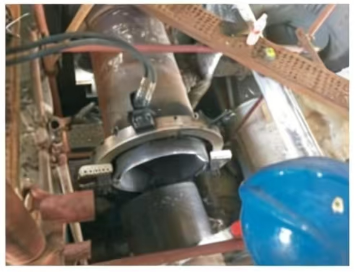
The split-frame pipe cutting and beveling machine (also called a clamshell cutter) is designed for one problem: the pipe end is not accessible. Valves, supports, equipment nozzles, and structural steelwork routinely block end-entry cutting tools — an orbital pipe cutter or a tube saw cannot clamp over the pipe end when there is no clear path from the open end. The split-frame machine opens laterally, wraps around the pipe at any point along its length, closes and locks onto the pipe OD, and machines the pipe in place.

The machine uses cold cutting throughout: a rotating tool slide carries the cutting/ beveling insert around the pipe circumference while the pipe stays stationary. Cold cutting avoids the heat-affected zones, thermal distortion, and hardening that flame cutting creates, particularly on alloy steel, stainless, and chrome-moly pipe where thermal treatment can invalidate the weld procedure qualification.

Bevel form is determined by tool selection and slide configuration against the welding procedure specification (WPS). V, U, Y, compound V, compound U, flange facing, and internal boring are all achievable by selecting the correct insert and slide combination before clamping on the pipe. The split-frame machine is the upstream step before FXT40 Pro + K-series or G168 track-type orbital welding on heavy-wall industrial pipe.

Drive selection: electric, pneumatic, hydraulic, or servo

Drive type is selected by application conditions. Electric motors are standard for controlled industrial environments. Pneumatic drives suit hazardous areas classified under ATEX / IECEx where a hot-work permit or motor-spark ignition is a concern. Hydraulic drives handle continuous heavy-duty load on thick-wall large-diameter pipe. Servo drives offer programmable feed rates and are used where bevel angle consistency must be documented for code-qualified WPS development. Drive selection should follow site EHS rules and the project hazardous-area classification.

02 / Key capabilities

What defines split-frame beveling in field conditions.

In-situ access

Opens around the pipe at any accessible point along the run. No pipe-end access required. Correct tool for installed manifolds, skid piping, valve replacements, in-service line repairs, and tie-ins where the line is cut and prepped in position.

Cold cutting

Machining, not thermal cutting. No heat-affected zone, no oxidation at the cut face, no hardening of alloy steel at the bevel surface. Produces a bevel face that meets WPS root face and angle tolerances without additional grinding.

Multi-bevel forms

V, U, Y, compound V, compound U, flange facing, and internal boring are configured by tool insert and slide selection. One machine covers the full bevel library for a project WPS — no tool change between pipe sizes, just insert change.

All standard pipe ODs

Model range from YPD-89 through YPD-426 and above covers ¾″ to 48″ (19mm to 1220mm) pipe OD. Confirm exact OD and schedule against the selected model before ordering — wall thickness affects slide selection.

Hazardous-area drives

Pneumatic and hydraulic drives for ATEX / IECEx classified work areas where electric motors require additional permitting. Drive selection follows site EHS classification and hot-work permit rules.

Supports WPS qualification

Bevel angle and root face produced by machine cutting are geometrically consistent across joints — a prerequisite for procedure qualification under ASME Section IX, API 1104, and EN ISO 15614. Servo drive option supports documented feed rates for WPS traceability.

03 / Workflow

Where split-frame beveling sits in the orbital welding process.

Heavy-wall pipe welding (> 2.5mm wall) requires a prepared bevel groove before orbital TIG welding. Without proper bevel preparation, the electric arc cannot reach the root of the joint, the weld pool cannot fill the depth, and root-pass defects — lack of fusion, incomplete penetration — result. The bevel geometry must match the WPS: V-groove for standard process pipe (35–37.5° per side, carbon steel), larger angle for stainless steel where pool viscosity is higher, U-groove for heavy-wall where a V-groove would require excessive filler volume.

The standard preparation workflow for heavy-wall orbital TIG welding is:

  1. Cut — CM series planetary cold cutter (if pipe end is accessible) or split-frame cutter (if pipe is in place). Achieves a square cross-section.
  2. Bevel — Split-frame beveling machine, configured per WPS: bevel angle, root face, and groove form (V / U / Y / compound). Root face ≤ 1mm for TIG orbital welding to achieve root-pass penetration.
  3. Clean — Degrease bevel faces and adjacent pipe OD (丙酮 / acetone or isopropanol), remove oxide film (stainless wire brush on stainless and titanium; grinding disc on carbon steel). Mandatory — oil, paint, and oxide are the primary sources of porosity in the root pass.
  4. Fit up and tack — Align pipe ends to within gap ≤ 0.5mm, misalignment < 10% of wall thickness. Tack weld 3–4 points at equal spacing, avoiding the 6 o’clock and 12 o’clock arc-start positions.
  5. Weld — FXT40 Pro + K-series open-head clamps (φ20–325mm) or G168 track-type system (≥ φ219mm). Root pass with AVC; fill and cap passes with oscillation per zone programming.
04 / Engineering specifications

Spec sheet for procurement — confirm exact model by pipe OD and wall.

Machine type
Split-frame clamshell cold cutting and beveling machine
Models
YPD-89 / 168 / 219 / 273 / 325 / 377 / 426 (and above on request)
Pipe OD range
¾″ to 48″ (19mm to 1220mm) across model range; confirm by model
Wall thickness
Standard slides for common wall thickness; heavy-duty slides for thick-wall pipe — specify at order
Cutting process
Cold machining — rotating tool slide · no heat-affected zone · no thermal distortion
Bevel forms available
V · U · Y · compound V · compound U · flange facing · internal boring
Bevel angle range
Configured by insert selection per WPS; standard 30–45° single bevel; confirm per project
Drive options
Electric motor · pneumatic · hydraulic · servo
Materials
Carbon steel · stainless 304 / 316L · chrome-moly alloy (P11 / P22 / P91) · duplex stainless · titanium alloy
Hazardous-area use
Pneumatic or hydraulic drive for ATEX / IECEx classified areas; confirm with site EHS
Standards fit
Bevel preparation for ASME B31.3 / B31.4 / B31.8 / Section IX · API 1104 · EN ISO 15614
Downstream welding process
FXT40 Pro + K-series (φ20–325mm) · G168 track-type (≥ φ219mm) · or qualified manual GTAW / SMAW
Warranty
12 months whole-machine · cutting inserts (consumables) excluded
05 / Common questions

What buyers ask before ordering.

Why split-frame instead of an end-entry cutter?

End-entry cutters (including the CM series planetary cutter) require unobstructed access to the pipe end to clamp on. In installed piping, the pipe end is almost always blocked by a valve, support, flange, or equipment nozzle. The split-frame machine opens around the pipe at any accessible point, without requiring end access. It is the correct tool for most field repair, tie-in, and in-service line work.

Which drive type should I choose?

Electric motors are standard and cover most controlled industrial environments. Choose pneumatic or hydraulic drives for ATEX / IECEx Zone 1 or Zone 2 classified areas where electric motors require additional hot-work permitting. Servo drives are used where feed rate documentation is required for WPS traceability in procedure qualification. Confirm your site’s hazardous-area classification with your HSE department before specifying the drive.

What bevel angle can the machine produce?

Bevel angle is configured by insert selection. Standard process pipe welding uses a single V-bevel at 30–37.5° per side (total included angle 60–75°) for carbon steel and 37.5–45° per side for stainless steel. U-groove and compound bevel configurations are set up by the tool slide and insert combination. Provide your WPS bevel specification when ordering and we will confirm the correct insert package.

Can it machine alloy steel pipe (P91, P22)?

Yes. Cold machining is preferable to flame cutting on chrome-moly alloy steel because thermal cutting creates a hardened heat-affected zone at the bevel face that must be removed by grinding before welding. The split-frame cold-cuts to finished bevel geometry without thermal effects on the base metal.

How is the model selection confirmed?

Specify pipe OD, wall thickness (or pipe schedule), material, required bevel form, and site drive type (electric / pneumatic / hydraulic). We will confirm the correct YPD model, slide configuration, and insert selection. For non-standard ODs or heavy-wall pipe outside standard slide range, provide the full pipe specification and we will quote the custom configuration.

→ Related

Upstream and downstream in the same workflow.

管道准备 · 现场坡口加工 · 分体框架夹壳式

分体框架管道切割坡口机。

夹壳式机体可在管道任何位置沿周向打开,锁紧后在原位进行冷切割或坡口加工——无需管端进入空间。专为炼油厂、化工、锅炉及现场修复作业设计,适用于标准端入式切割工具无法到达的场合。V形/U形/Y形/复合坡口。电动、气动或液压驱动。

FCA洛阳 · 按需报价——请注明管道外径、驱动类型和坡口形式
型号 YPD-89 / 168 / 219 / 273 / 325 / 377 / 426及相关尺寸
管道外径 3/4英寸至48英寸(19mm至1220mm)范围覆盖
坡口形式 V形 · U形 · Y形 · 复合V形 · 复合U形 · 法兰端面加工 · 内孔镗削
驱动方式 电动 · 气动 · 液压 · 伺服
质保 整机12个月
01 / 产品概述

可在已安装管道外侧打开的分体框架夹壳式机器,用于原位冷切割和坡口准备。

分体框架管道切割坡口机(又称夹壳式切割机)专为解决一个问题而设计:管端无法进入。阀门、支架、设备接管嘴和钢结构件经常阻挡端入式切割工具——当开口端没有畅通路径时,轨道管道切割机或管锯无法夹持在管端。分体框架机器横向打开,沿管道长度任意位置包裹管道,闭合并锁紧在管道外径上,原位对管道进行加工。

该机器全程采用冷切割:旋转刀具滑台携带切割/坡口刀片绕管道圆周运动,管道保持静止。冷切割避免了火焰切割产生的热影响区、热变形和硬化,特别适用于合金钢、不锈钢和铬钼钢管道,热处理可能使焊接程序资质失效。

坡口形式由刀具选择和滑台配置根据焊接工艺规程(WPS)确定。V形、U形、Y形、复合V形、复合U形、法兰端面加工和内孔镗削均可通过夹持管道前选择正确的刀片和滑台组合来实现。分体框架机器是重壁工业管道FXT40 Pro + K系列或G168导轨式轨道焊接前的上游工序。

驱动选择:电动、气动、液压或伺服

驱动类型根据应用条件选择。电动机是受控工业环境的标准配置。气动驱动适用于ATEX / IECEx危险区域,该区域存在动火许可或电机火花点火风险。液压驱动适用于厚壁大管径管道的持续重载作业。伺服驱动提供可编程进给速度,用于需要记录坡口角度一致性以进行规程认证WPS开发的场合。驱动选择应遵循现场EHS规定和项目危险区域分类。

02 / 核心功能

分体框架坡口加工在现场条件下的特点。

原位操作

可在管道运行段任何可进入点处打开。无需管端进入空间。适用于已安装集管、橇装管道、阀门更换、在役管线修复及需在原位切割和准备管线的连接作业。

冷切割

机械加工,而非热切割。无热影响区,切割面无氧化,坡口面合金钢无硬化。加工出符合WPS钝边和角度公差要求的坡口面,无需额外打磨。

多种坡口形式

V形、U形、Y形、复合V形、复合U形、法兰端面加工和内孔镗削通过刀具刀片和滑台选择来配置。一台机器覆盖项目WPS的完整坡口库——不同管径之间无需更换刀具,只需更换刀片。

覆盖所有标准管道外径

YPD-89至YPD-426及以上的型号范围覆盖3/4英寸至48英寸(19mm至1220mm)管道外径。订购前请对照所选型号确认确切外径和管道等级——壁厚影响滑台选择。

危险区域驱动

气动和液压驱动适用于ATEX / IECEx分类作业区域,该区域电动机需要额外许可。驱动选择遵循现场EHS分类和动火许可规定。

支持WPS资质认证

机械切割产生的坡口角度和钝边在各接头间几何一致——这是ASME第IX节、API 1104和EN ISO 15614规程认证的先决条件。伺服驱动选项支持记录进给速度以实现WPS可追溯性。

03 / 工作流程

分体框架坡口加工在轨道焊接工艺中的位置。

重壁管焊接(壁厚 > 2.5mm)在轨道TIG焊接前需要预备坡口槽。没有适当的坡口准备,电弧无法到达接头根部,焊接熔池无法填充深度,将产生根部焊道缺陷——未熔合、未焊透。坡口几何形状必须与WPS匹配:标准工艺管道用V形坡口(碳钢每侧35–37.5°),熔池黏度较高的不锈钢用更大角度,重壁管用U形坡口(V形坡口需要过量填充量时)。

重壁管轨道TIG焊接的标准准备工作流程为:

  1. 切割 — CM系列行星式冷切割机(若管端可进入)或分体框架切割机(若管道已就位)。实现垂直截面。
  2. 坡口加工 — 分体框架坡口机,按WPS配置:坡口角度、钝边和坡口形式(V形/U形/Y形/复合)。TIG轨道焊接钝边 ≤ 1mm以实现根部焊道熔透。
  3. 清洁 — 脱脂坡口面和相邻管道外径(丙酮 / acetone或异丙醇),去除氧化膜(不锈钢和钛用不锈钢丝刷;碳钢用砂轮片)。必须执行——油脂、油漆和氧化物是根部焊道气孔的主要来源。
  4. 组对和定位焊 — 对齐管端至间隙 ≤ 0.5mm,错边 < 壁厚的10%。在等间距3–4个点进行定位焊,避开6点钟和12点钟起弧位置。
  5. 焊接 — FXT40 Pro + K系列开式焊头卡具(φ20–325mm)或G168导轨式系统(≥ φ219mm)。根部焊道配合AVC;填充和盖面焊道配合分区摆动编程。
04 / 工程规格

采购用规格表——按管道外径和壁厚确认具体型号。

机器类型
分体框架夹壳式冷切割坡口机
型号
YPD-89 / 168 / 219 / 273 / 325 / 377 / 426(可按需定制更大尺寸)
管道外径范围
3/4英寸至48英寸(19mm至1220mm),跨型号;按型号确认
壁厚
常规壁厚用标准滑台;厚壁管道用重型滑台——订购时注明
切割工艺
冷机械加工 · 旋转刀具滑台 · 无热影响区 · 无热变形
可用坡口形式
V形 · U形 · Y形 · 复合V形 · 复合U形 · 法兰端面加工 · 内孔镗削
坡口角度范围
按WPS刀片选择配置;标准30–45°单面坡口;按项目确认
驱动选项
电动机 · 气动 · 液压 · 伺服
适用材料
碳钢 · 304 / 316L不锈钢 · 铬钼合金(P11 / P22 / P91) · 双相不锈钢 · 钛合金
危险区域使用
ATEX / IECEx分类区域用气动或液压驱动;与现场EHS确认
适用标准
坡口准备适用于ASME B31.3 / B31.4 / B31.8 / 第IX节 · API 1104 · EN ISO 15614
下游焊接工艺
FXT40 Pro + K系列(φ20–325mm) · G168导轨式(≥ φ219mm) · 或合格手工GTAW / SMAW
质保
整机12个月 · 切割刀片(消耗品)不在质保范围内
05 / 常见问题

买方在订购前的提问。

为何选择分体框架而非端入式切割机?

端入式切割机(包括CM系列行星式切割机)需要畅通的管端进入空间才能夹持。在已安装管道中,管端几乎总是被阀门、支架、法兰或设备接管嘴所阻挡。分体框架机器在任何可进入点处绕管道打开,无需管端进入空间。它是大多数现场修复、连接和在役管线作业的正确工具。

应选择哪种驱动类型?

电动机是标准配置,适用于大多数受控工业环境。对于ATEX / IECEx 1区或2区分类区域(电动机需要额外动火许可),选择气动或液压驱动。伺服驱动用于规程认证中WPS可追溯性需要记录进给速度的场合。订购前请与您的HSE部门确认现场危险区域分类。

机器能加工什么坡口角度?

坡口角度通过刀片选择来配置。标准工艺管道焊接对碳钢使用每侧30–37.5°的单面V形坡口(总包角60–75°),不锈钢每侧37.5–45°。U形坡口和复合坡口配置通过刀具滑台和刀片组合来设置。订购时提供您的WPS坡口规格,我们将确认正确的刀片套件。

能加工合金钢管道(P91、P22)吗?

可以。冷机械加工优于铬钼合金钢的火焰切割,因为热切割会在坡口面产生硬化热影响区,焊接前必须通过打磨去除。分体框架冷切割至成品坡口几何形状,对母材无热影响。

如何确认型号选择?

请注明管道外径、壁厚(或管道等级)、材料、所需坡口形式和现场驱动类型(电动/气动/液压)。我们将确认正确的YPD型号、滑台配置和刀片选择。对于非标准外径或超出标准滑台范围的厚壁管道,请提供完整管道规格,我们将报价定制配置。

→ 相关产品

同一工作流程中的上游和下游。

Contact us for a quote

FAQ

  • What is a split frame pipe cutting and beveling machine?

    A split frame pipe cutting and beveling machine (also known as a clamshell pipe cutter) is a portable, ring-style machine designed for on-site pipeline processing. Its unique split-type structure allows it to open and install around any part of a pipeline, making it ideal for pipes where the ends are inaccessible. It can perform cutting and beveling simultaneously or separately on various materials like carbon steel, stainless steel, and alloy steel.

  • What are the main advantages of using a clamshell split frame machine?

    The primary advantages include its on-site installation capability, cold cutting process (no heat-affected zone), and compact radial clearance. It eliminates the need to disassemble pipelines and is perfect for confined spaces like pipe galleries. By completing cutting and beveling in one operation, it significantly reduces downtime and improves efficiency in emergency repairs.

  • What pipe diameters and wall thicknesses can your split frame machines handle?

    Our split frame machines cover a wide processing range from 3/4" to 48" (Φ20mm to Φ1230mm). Depending on the model, we offer standard cutter holders for wall thicknesses up to 30mm and heavy-duty holders for ultra-thick pipes up to 110mm. We also provide non-standard custom designs for larger diameter pipelines upon request.

  • What are the available drive methods for the FYID split frame pipe cutter?

    We offer four versatile drive methods to suit different working environments: Electric: Convenient for standard power supply (220V). Pneumatic: Explosion-proof and safe for oil and gas environments. Hydraulic: Provides strong power and low noise for heavy-duty continuous operations. Servo: High-load bearing with high precision and low noise.

  • Is the split frame pipe machine safe for use in flammable and explosive environments?

    Yes. Our machine utilizes a cold cutting process that generates no sparks, no open flames, and no heat-affected zones (HAZ). When combined with a pneumatic drive, it is highly suitable for high-risk, flammable, and explosive environments such as oil refineries, gas pipelines, and chemical plants.

  • What types of pipe bevels can this machine produce?

    The FYID split frame machine is highly versatile, capable of processing V-type, U-type, Y-type, and compound bevels. It can also handle chamfering, edge cutting, and even raised face flange processing after welding. Standard tool angles include 0°, 30°, 37.5°, and 45°.

  • How does the split frame machine adapt to confined spaces?

    The machine is designed with a small radial clearance (low-profile design). For example, the 6" model requires only a small radial space to rotate, making it ideal for tight equipment rooms or underground pipe galleries where traditional large-scale machinery cannot fit.

  • What if the pipe is deformed or elliptical?

    We offer a specialized Roundness Compensation Cutter Holder. This accessory is designed to track the surface of deformed or elliptical pipes, ensuring a uniform bevel even on imperfectly round pipelines with a wall thickness up to 110mm.

  • What is the delivery schedule for standard and custom split frame machines?

    Standard models are typically shipped within 5-10 working days. For non-standard custom products tailored to specific technical requirements, the delivery period is usually 15-20 working days. We offer both international air (10-15 days) and sea freight (30-45 days) options.

  • What technical support and warranty do you provide for international customers?

    We provide a 12-month whole-machine warranty and lifetime technical support. Our team offers 7×18 hours online video support in English and Chinese. For major domestic cities, we offer on-site service within 72 hours, and for overseas customers, we provide remote diagnosis, video guidance, and rapid spare parts shipping (within 48 hours).